
June 5, 2025
Our Amazing Brains: A Back to School Unit

Upon the first few weeks of school teachers always set out to spend that time establishing classroom norms. You know, the routines and procedures students must learn in order for the classroom to function normally. This school year ahead, I've found myself reflecting on the needs of my class last year and thinking of ways I can better support them. That's when I realized I wanted to spend more time in those first few weeks of the new school year discussing the brain.
I knew I wanted my lessons to build upon each other and relate to how our brains help us learn and grow. In my research for this resource I found myself becoming more and more fascinated with the brain and just how awesome it is!
Lesson 1: Our Amazing Brains
In this first lesson, students are introduced to the brain and its function. It is explained as our "super computer" and they will learn that the brain can be divided into different sections:
- Frontal Lobe (incl. prefrontal cortex): think, plan, solve-problems, our personalities
- Parietal Lobe: movement, speed, the senses, and writing
- Occipital Lobe: memory, sight, smell
- Temporal Lobe: speech, language, and hearing
- Cerebellum: balance, coordination, and fine motor skills
- Brain Stem: connects the brain to the spinal cord

- Labeling the Brain: a straightforward worksheet where students label the lobes/parts and color code it based on the function of each part.
- Interactive Journals: flap-book style notes where students cut and glue flaps into their journals and practice note-taking. They'll identify the part of the brain and lift the flap to write its function.
- Brain Hats: This activity is more advanced and for those students who can handle the number of directions. But, the finished product is pretty cool and a great engaging activity. I've also included a simpler version using construction paper and step-by-step directions.
Lesson 2: Growth Mindset

- "I'll try again"
- "I'll ask for help or try a new way"
- "My brain is getting stronger"
- "Mistakes help my brain learn"
Lesson 3: Problem-Solving Brains

- Station 1: Thinking & Planning Zone (thinking of 2 ways to solve the problem)
- Station 2: Remembering & Learning Zone (thinking of 1 way you've learned from a mistake)
- Station 3: Creative & Idea Zone (draw a quick picture of how you might solve the problem)
- Station 4: Brave Action Zone (strike a pose that shows you're going to take a brave step)
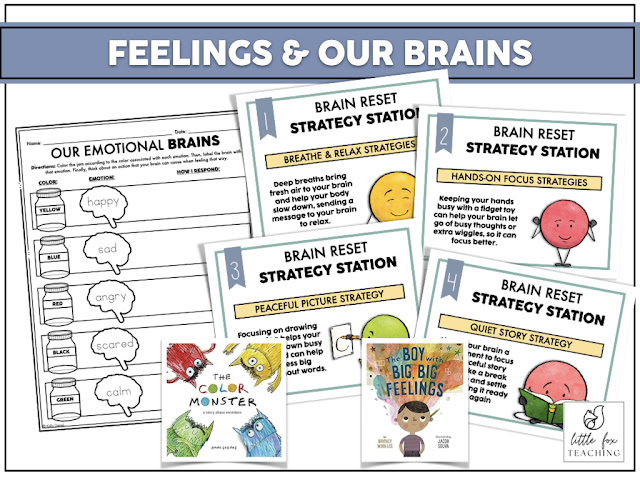
Lesson 4: Feelings & Our Brains
Lesson 5: Regulating Our Emotions
 |
| My Calm Corner at the beginning of the school year. (2024) |
The Calm Corner
- Breathe & Relax (breathing tools/cards, finger tracing, pinwheels)
- Hands-On Focus (fidget tools, stress balls (different textures), sensory bottle)
- Peaceful Picture (whiteboard or notepad for quick pictures, Think Sheets are another great option)
- Quiet Story (picture books (about emotions))


February 14, 2025
From Time-Outs to Think Sheets: How Social-Emotional Learning is Transforming Our Classrooms

It wasn't that long ago that "bad behavior" was often seen as a character flaw. Students who acted out were labeled as troublemakers, and the focus was on punishment rather than understanding the root cause of their actions. Now, we recognize that challenging behaviors are often a signal - often of things that lie beneath the surface. They might indicate a student is struggling with anxiety, frustration, or difficulty regulating their emotions. My son, who is autistic, faces challenges with emotional regulation. This, too, can be true for the many neurodivergent students we receive in our classrooms. This shift in perspective is crucial because it allows us to move away from punitive measures and towards support and intervention.
Reshaping Our Classrooms
 |
| Calm Corner at the beginning of the year. |
So, how has SEL reshaped our classrooms? It's not just a curriculum or a set of lessons; it's a fundamental change in our approach. We're now prioritizing creating a safe and supportive learning environment where students feel seen, heard, and understood. We're teaching them explicitly about emotions, self-awareness, responsible decision-making, and relationship skills. We're fostering empathy and encouraging them to develop a growth mindset. And most importantly, we're building strong relationships with our students, creating a foundation of trust that allows for open communication and effective support.
So, how does this look in my classroom?
My 2nd graders have benefited tremendously from our "Calm Corner." It's a designated space where they can take a break, regulate their emotions, and then rejoin the class ready to learn. I've been so pleased to see how readily and effectively most of my students have used it. At the beginning of the year it starts pretty minimally - just a few physical and visual tools. Throughout the year, we collaboratively build and refine the space, adding additional tools and visuals as specific needs arise. Each addition is introduced and discussed beforehand, ensuring the students understand not only how to use the individual tools but understand the overall purpose of this special space.
In this space there is one tool, in particular, that is so helpful for students to not only express their feelings, but be able to communicate effectively about them.
The Think Sheet: Reimagined
One of the most powerful tools that has emerged in this SEL-focused landscape is the "Think Sheet." While the concept might seem simple, its impact can be transformative. Think Sheets provide a structured way for students to reflect on their behavior, identify their feelings, and understand the connection between the two. Instead of simply reacting to a situation, students are guided through a process of self-discovery.

The Think Sheets I've created include prompts that encourage students to:
- Describe what happened: This helps them objectively recount the situation without assigning blame.
- Identify how they were feeling: This is crucial for building emotional awareness. Often, students act out without fully understanding what's driving their behavior.
- Consider what they could have done differently: This encourages problem-solving and the development of alternative strategies.
- Think about how their actions affected others: This fosters empathy and perspective-taking.
By working through a Think Sheet, students begin to understand that their feelings influence their choices. They learn that they have the power to manage their emotions and make different decisions in the future. This is a powerful realization that empowers them to take ownership of their behavior and develop valuable self-regulation skills.
Think Sheets aren't a magic wand and won't solve every single circumstance, but they are a valuable tool in our classroom. They provide a framework for meaningful conversations with students and offer a tangible way for them to develop self-awareness and emotional intelligence. When used consistently and with empathy, these Think Sheets can be a catalyst for positive change, helping students learn and grow both academically and emotionally.
As educators, we are constantly learning and evolving, and the integration of SEL and tools like Think Sheets represent a significant step forward in creating classrooms where all students can thrive and belong.

Hey there!
