
March 25, 2021
A Study of Snails | Kindergarten Science Unit


Last year was the very first year I learned about snails alongside my students. I was excited for this unit - a part of our study of the garden/plants - because I had always taught about butterflies. Although fun, it's been done so many times and to have the opportunity to learn about snails was something new...even for me!
When I taught as a kindergarten English teacher for a French-American school, my French colleagues taught the science and French language aspect of this unit whereas I was responsible for teaching my ELA objectives, but through the theme of snails. You can read all about my lesson ideas and what I did in ELA for snails here.

But now that I'm back to being a SAHM I thought it would be fun to create something that other teachers could use or even parents who may be distance learning still or homeschooling. Although what my French colleagues came up with was so fun to observe, there would be no way I could get everything translated. So, I chose to create a workbook that covers the basics of this unit and the scientific skills that go with it!
Here's what's inside!
An introduction to snails!

Life Cycles & Anatomy

Recommended Watching
Making Observations & Fine Motor Practice
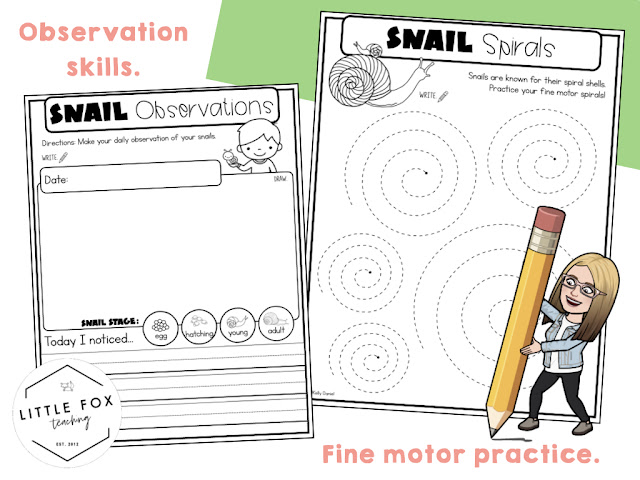
Choose your observation note style

A home observation & new class pet


- large aquarium tank with a ventilated covering
- dirt from outside
- collection of sticks, plants, and rocks (places for snails to hide are great!)
- a spray bottle of water to keep things moist inside
- snails love fruits and veggies (avoid citrus) and leafy green leaves
- they also love calcium (to keep their shells strong) so items like cuttlefish bones and egg shells are great to include in the tank
April 23, 2020
Plants & Gardens Unit | Snails

You can read my full disclosure policy here.
This week we're officially on spring break and it couldn't have come at a better time. Although this spring break does look a lot different than the one we had planned. We had to cancel our trip to Texas to visit family and even though I'm on break, my day-to-day routines haven't changed very much. I still wake up (admitting, later than usual) and find myself managing time between a full day with my son, checking email, and finding time to do things for myself in between.
However, now that I've found this new sense of time I thought it would be fun to finally get on here, spruce some things up (did you notice the slight website theme change??) and share what my kinders and I have been up to leading up to our break!
Exploring Spring
Spring had sprung a couple months ago and in English class with my kinders I took full advantage and kicked off our spring ELA theme! There has been so much learning, exploration, and fun these last couple of months - with this last month being our first with distance learning. If you've been following along, we've covered:And to wrap up our spring theme last week we learned about snails!
Snails! Les Escargots!


One of the awesome aspects to working at a French-American school is that I am exposed to a whole new way of teaching. From instruction to curriculum and, as a teacher, it's been amazing to learn and observe my French colleagues teach. With that being said, one unit in particular that I was most curious about was....snails!
Snails?
Yes, snails.
This was a first for me and I couldn't wait. Typically in kindergarten there's always a unit on life cycles and a popular life cycle to study, in my experience, has been with butterflies. They're easy to manage, the kids are excited to have new visitors in class, and they get to observe life happen right in front of their eyes over a few week period. However, at my school in kindergarten they learn about snails!
Over the last month (even with distance learning) I've found myself really enjoying this unit. From the days prior to schools being cancelled and seeing the kids light up as the terrariums were set up in the classroom to observing the first batch of eggs that were laid. Although much of their snails unit in French has been online, it hasn't the learning and excitement around these little creatures.
Snails and ELA

In English, students will use their background knowledge about snails to assist them in their understanding of the English language through read alouds, vocabulary work, phonics activities, and crafts. Meanwhile, students are beginning to learn about how to reflect and connect to their reading. Which brings me to our reading focus for the week...
Making text-to-self connections!
We're at the part of the year where students have really built upon their understanding of story foundations such as: story structure, story elements, who the author and illustrator are and their purposes, as well as
For distance learning purposes I decided to create a YouTube channel for my students. On this channel I have read alouds, handwriting, and activity explanations. This has been an extremely helpful platform to use for distance learning because of how easily I can create content, upload it directly from iMovie, and even share the link via my class' Seesaw.
For example, as we launched our text-to-self connections during garden week I created this video to introduce my students to the concept of how we can relate to the stories we read. I included this video as well as the read alouds (also found on my channel) in my lesson plans so that my students could find everything needed for specific lessons.
Reading Skill: Text-to-Self Connections
Because my French colleagues taught the science component of this unit, I wanted to focus on the language arts aspect with English vocabulary and developing their abilities to relate to the stories they read with text-to-self connections. We've been working on these kinds of connections and snail week will be our final one. It's one of the easiest for students to grasp and therefore the first one we tackled. Here's how I blended our unit on snails with ELA skill-building!Reading: Text-to-Self Connections
I used this freebie from Camp Kindergarten all week with my read alouds and activities. It's a great visual organizer for my kinders and gives them plenty of space to draw pictures - it's also a great tool to upload to Seesaw as an activity. With making connections, students would read (or listen) to a story and then draw a picture using details from the story and their own memories connecting the two.
 |
| Photo | Camp Kindergarten (FREEBIE) |
 |
| Amazon: $10.99 |
 In this story, Escargot is a snail who so badly wants two things in life: to be the readers' favorite animal and to eat the salad at the end of the story. However, when he finally gets to the salad he realizes there's a carrot on it...and Escargot hates carrots! This is the perfect story for my students to practice text-to-self connections because who are the world's pickiest eaters?? Kindergartners!
 |
| Amazon: $9.99 |

In addition, this story has a great SEL opportunity as well with: self-esteem, appreciating your own uniqueness, and understanding we're perfect as we are; that we should pretend to be something/someone we're not. There are a ton of stories with this message that can be used for text-to-text connections in addition to this one!
Snail Crafts
 |
| Photo | Toddler at Play |
Fine Motor Practice
 |
| Photo | Messy Little Monster |
 |
| Photo | Fiche-Maternelle |
Playdoh Snails
Working with playdoh (we made ours at home!) is a great way to build up fine motor skills, but it's great for expression of creativity as well! Greyson really enjoyed making homemade playdoh with me and I've been enjoying the hours of play...
For Fun: Snail Racing!
 |
| Photo: Kids Craft Room |
And that's a wrap for our snails unit!
Hey there!
