June 20, 2023

Boho Minimalist Schedule Cards
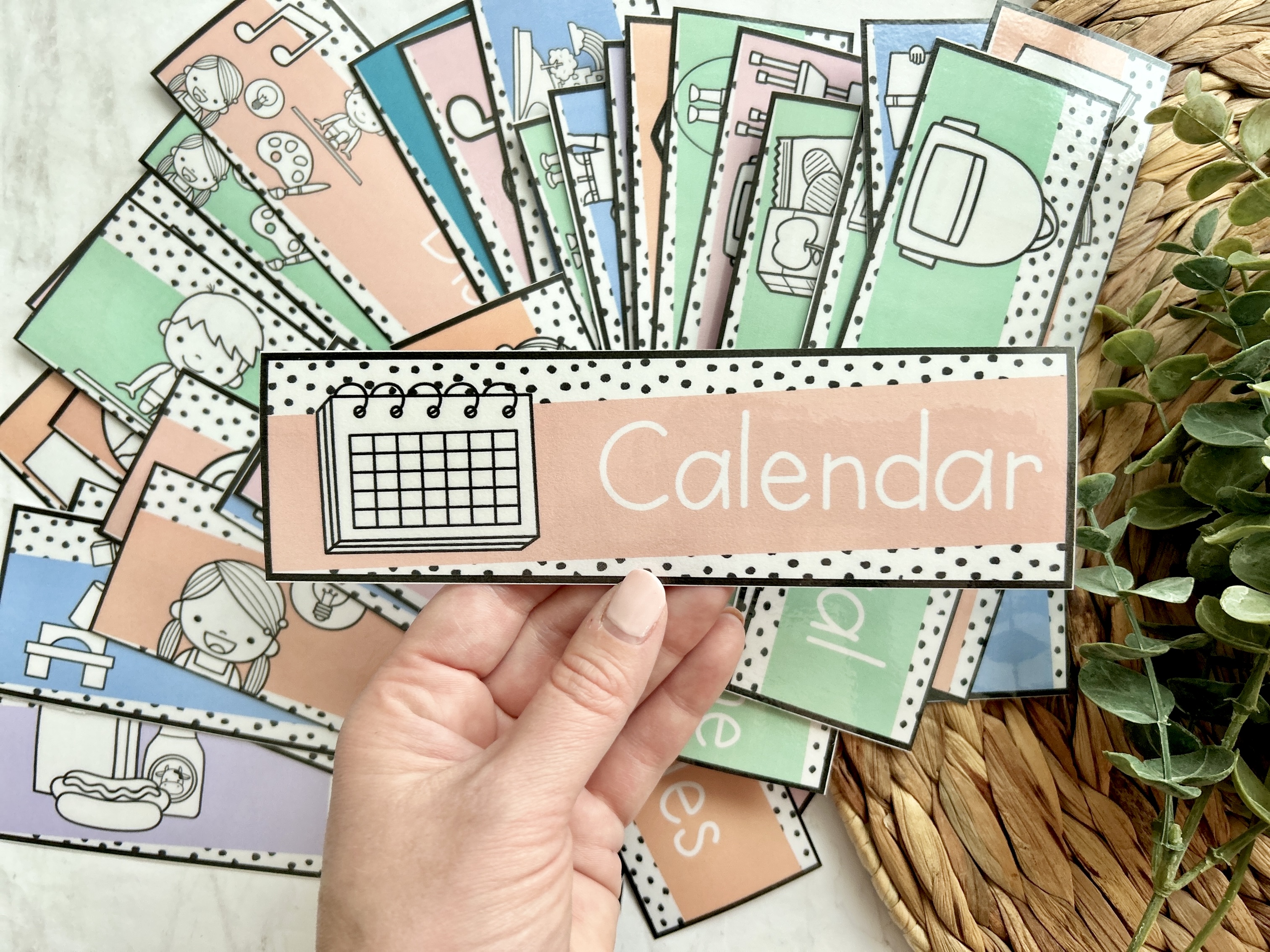


It's summer which naturally it means I'm also doing the very thing I shouldn't....and that's thinking ahead to next year.

It's hard for me to sit still and not use this time to think about how I'd like to setup my classroom, add or change things up, or create some new resources. My time is so valuable - don't get me wrong, our family has PLENTY planned for July - but it's even more valuable during the school year when I don't have much of it to dedicate to these things. So, I personally enjoy using this slower-paced time in my life to reflect and gear up for the year ahead.

So, as I'm looking around teacher Instagrams I'm noticing this boho naturals trend and I have to say that I'm not mad at it. I love that classrooms are beginning to get away from a lot of those distracting and overwhelming classroom decor and somewhat getting student-centered again. However, I do find a lot that is more style than substance...at least for me and what I would like to do for my kinders. Thus, I set out to create my own resources and here I am sharing what all I've been up to.

Student-Centered

This is by-far the most important thing I keep in mind when setting up my classroom. My son, who has ASD (Autism Spectrum Disorder), has taught me a lot over the years about overstimulation and how that may affect different kids. Overstimulation can trigger all sorts of behaviors in students and therefore I try to keep the sensory levels pretty minimal when it comes to how I decorate and organize my classroom. Calm students = focused, engaged, and happy learners!

Daily Schedule Cards

As you can see my schedule cards this year are going to be black and white with little pops of color. The clipart I've intentionally kept black and white as to pop a little bit but not be overwhelming to the eye. The other important thing I keep an eye out is the use of fonts in products. So many times do I see something I'd love to download from TpT, but the font is completely wrong for my students here in kindergarten. Often they're a funky script or even the all caps fonts can be challenging to read...so cute for us adults scrolling social media, but not very student-friendly. Especially students who are just learning to read and write.

In my own products I always keep to simple fonts that reinforce the types of letter formation that I am teaching my students and what I expect for them to reproduce for me in their own writing. It also makes it easy-to-read and the B&W clipart is simple and doesn't overwhelm the eyes. Who knew so much thought goes into something as simple as this!


I am so excited to continue adding to this boho theme with various other products for organization! I hope you like it and if you're interested in adding this to your classroom you can find it over on my TpT shop page!


June 8, 2023

Simplifying Science of Reading in Kindergarten


When I first started teaching in 2011 the district I worked for used Jan Richardson's text Next Steps in Guided Reading. It was like our Bible for small group reading instruction and for years I used that as a means to organize my groups and lessons. However, over the years and working in multiple counties, and even states, I've learned a number of things along the way that helped me simplify the daunting task of guided reading.


Guided Reading is a small group instructional practice where students are grouped based on need in their reading. It allows teachers to target specific learning goals and work with students towards mastery of those goals with a scaffolded instructional format. As a new teacher it seemed simple enough, but I remember feeling so overwhelmed since a lot of the planning had to be done by me...someone who didn't know much at the time about what guided reading should look like.

Now, ten years later, and most of which in kindergarten, I'm happy to be in a place where I feel like I can help other teachers out by simplifying what this small group time should look like in kindergarten.


Small Group Organization

Much like anything, the first step of guided reading is getting yourself organized. This means creating a space in your classroom where students meet with you and stocking that space with the items you'd need for your lessons. Keeping them within reach is vital to utilizing your small group time effectively.

In my own small group space I have:
  • Stick-on Whiteboard Table Stickers (perfect for ready-to-use whiteboards that stick right to the table).
  • A caddy filled with: whiteboard markers/erasers, pencils, scissors, glue sticks (having these tools on the ready allow students to not worry about bringing their own pencil boxes/supplies).
  • Fun items: finger googly-eyes, festive fingers, etc. for making tracking fun
  • Flashcards with ABCs, magnetic letters, sand boxes, etc.

Binders are also a great way to organize the lessons you'll teach - whether you purchase teacher-made resources for guided reading or are writing your own lesson plans with books provided by your school. Either way, binders are a great way to keep you organized all year long.

Assess Your Students

Before you meet with any groups you'll need to assess students and record their skill-sets. From these assessments you'll be able to find areas of need and group students by similar need. Formal assessments like the DRA or IRIs will give you a more informed understanding of your students' actual reading levels.

In kindergarten I always begin with students who are pre-readers and need help with letter identification and matching letters to their sound. That will be their first learning target in guided reading!

Planning Guided Reading Lessons

There are two things you can do when it comes to planning the lessons you'll teach: 
  • purchase pre-made lessons via teacher-authors on TpT and other marketplaces 
  • or write the plans yourself using a template and guided reading books provided by your school.
Both are great options! 

Pre-Reader Lesson Plans

In kindergarten, many of my students are pre-readers at the beginning of the year. This means their learning targets in guided reading will be letter identification and matching letter sounds. For this, I've created a comprehensive level AA (pre-readers) resource with pre-made lesson plans! Yes! I walk you through each letter and sound step-by-step, which saves you a ton of time!


Each letter has its own scripted lesson plan and I've made sure to make it such a breeze to follow. It covers a variety of skills and keeps the lesson within a 10-15 minute timeframe - making it perfect for small group instruction. Each letter has a plan, printable letter cards with proper mouth formation, and a sound sort for students to complete. I also provide ABC charts and a guided writing template.


Emergent Readers (A-D) Lesson Plans

As students continue to grow in their letter ID/sounds they're ready for decodable readers! As your students move into this next stage of their reading I have a brand new resource for you! 

As emergent readers your students are beginning to acquire reading skills such as tracking, decoding, and metacognitive skills like thinking about their reading (i.e. becoming aware of their mistakes and learning to self-correct or check the picture for understanding). This is such an exciting time in kindergarten and my next resources helps make planning for these levels so simple! Let's take a peek!


Lesson Plan Templates: 
Each level from A-D I have simplified the lesson plan template to make it easy to follow along and target level-appropriate goals. I have outlined a quick warm-up, sight word review, and teaching points (which vary depending on level). 

Simply select a decodable reader or guided reading leveled book and follow the step-by-step sections! That's truly it!


An easy warm-up for your emergent readers are segmenting and blending! This gives your students a chance to practice a key skill that they'll be using in their reading as they begin to decode.

Segmenting & Blending
I've included work mats for vowels: a, e, i, o , and u where students track each letter sound and using a dry erase marker write the letter. Then, they'll blend it altogether to say the word. 


Reading Skill Posters
Lastly, I've included these easy-to-use posters where you can display in your reading area for daily practice. These skills will be the main skills students will be practicing all year long in their small groups and eventually on their own! 


Happy Reading!

I hope you've found this to be a little helpful as you begin to plan your reading groups this upcoming school year in kindergarten (or even first grade!). I wish you the best of luck!!


February 26, 2023

Sub Tub: Complete Sub Plan Lesson Plans for Fall



We've all been there as teachers...

...needing to call in and take a day (or a few) and stressing over how to prepare and plan for having a substitute while you're away. I remember feeling so ill one time and while keeled over my laptop I was quickly putting together a sub plan, emailing my team, linking all the things...and I remember thinking to myself: never again!

Prepping for a sub shouldn't be stressful and one way to beat that stress is to have a system in place where all of your emergency sub plans are already prepped and sitting, waiting to go. For me, that's the SUB TUB!


What is a Sub Tub?


Simply put: it's a container that you have pre-prepped lesson materials for multiple days or even weeks. It stays in an obvious place like near your desk or on a shelf (not tucked away in a closet) and easily accessible for any substitutes heading to your room.

What's inside a Sub Tub?


For me, I have lesson activities that span Phonics, Reading, Writing, and Math. I also have additional activities that are for fun and time-filler activities in case the sub is in need of something to keep my kiddos busy for those random 5-10 minutes before lunch or specials. 

The great thing is...you can fill your tub with anything you want! It's completely customizable to your class and the concepts your teaching!


Prepped Kindergarten Plans!

There's nothing like just having to hit the print button and make a simple round of copies and have your tub instantly filled. That's exactly why I set out to creating a resource for teachers to help them manage their time and efforts - especially when those dire moments pop up and we need to be away from our classrooms.

This resource focuses on review concepts for phonics, reading, writing, and math but with a fall/back to school theme. It's perfect for the beginning of the year but also has activities that lend itself for throughout the year too (i.e. story maps and name writing).


What's Included?

This resource is all about having every base covered from the morning to the afternoon for your sub.
In kindergarten in the fall we're just beginning those early learning concepts and that is what inspires this resource the most. Here's what's inside...
  • Phonics: missing ABCs, beginning sounds, rhyming words, letter sound hunt


  • Reading: story map, story elements, favorite part and favorite character response sheet
  • Writing: name practice, rainbow writing, and basic writing template paper for writing prompts


  • Math: number tracing 1-20, pumpkin 10-frames, subitizing color-by-number, comparing sets, one more/less practice


Sub Tub Template


Before you run off, here is another resource I use with my Sub Tub and which is completely 100% editable right in the PDF! It's a template for your tub where you include all of the important info about your class and how the day runs. It also includes a reflection page for your sub to jot down and share how the day went. I've been using mine for a year now and it makes organizing my class a breeze!


Happy teaching and cheers to making sub plans a breeze this year!


February 15, 2023

Science of Reading: Level A Guided Plans


If you've been teaching these last few years you've probably noticed a big shift in literacy instruction. The latest approach is called the Science of Reading. Last year my district here in Texas made the leap and all teachers, veteran to new, was required to take the new SoR training. 

What makes this approach different than all the others, and one I'm personally on board with, is that it is research and evidence supported. Much of the SoR training had us learn about the parts of the brain and how it acquires language. With this knowledge, teachers are better equipped to implement reading instruction in a way that supports student learning. After my own training I had a better idea on what best practices are for teaching reading at the kindergarten level.

Launching SoR in Kindergarten

One of the biggest goals at the end of any kindergarten year is to get students familiar with letter recognition and be able to match those letter sounds. In addition, as a kindergarten teacher it's my job to make sure that students are also exploring books, practicing fundamental reading strategies, and thinking about their reading through discussions. How does all of this happen? In whole group, yes, but a big chunk of it is through guided reading!

At the kindergarten level I see a lot of my students coming into the year with little to no letter knowledge - even with daycare or pre-k experience. Which means we hit the ground running at the start of the year with letter ID and letter sound work. The SoR equips us teachers with a Sound Wall, which is a replacement of the Word Wall (although I blend the two in my classroom) and every day we review the unlocked sounds (i.e. the sounds we've introduced in whole group phonics lessons) and their motions.

** I use Natalie Lynn Kindergarten's Sound Wall resource and it comes with corresponding motions for each letter sound. I've seen it work wonders with helping my kinders remember and retain their letter sounds and couldn't recommend it more.

During our reading block we explore big-picture reading concepts that I model and students practice independently. Then, we're off to reading stations and I can pull small groups. This is where the magic really happens!

Guided Reading with Pre-Readers

A big chunk of my groups are pre-readers - those students who do not have enough letter knowledge to begin the next step of decoding. So, this means we focus a lot on identifying uppercase and lowercase letters, the mouth articulation of the letter sound, and picture sort activities where students practice matching the word with the sound to the letter.

So how do I plan and prep for these activities? Luckily I took the time to lay it all out and I'm so excited to share this resource with all of you!

Scripted Lesson Plans

For each letter I've scripted out each lesson plan! No more sitting at your desk wondering what to do! It's all right there for you. 


Each lesson begins with a phonemic awareness (PA) warm-up where students listen to alliteration sentences. They are to identify the sounds at the beginning of each word and count the number of words in the sentence. This helps them practice readiness skills such as features of print and phonemic awareness.

Then, in the lesson itself you introduce the grapheme (the letter form) as well as the mouth formation and articulation of the letter sound. I've provided these cards in the resource as well so all you have to do is print and go! I keep a binder with my lesson plans printed and any additional visuals, activities, etc. ready to go so that when I pull my groups my lesson is already prepared.


Afterwards, students practice with a sound picture sort where they are to cut and sort picture cards to the right sound. Then, to wrap everything up, students do a little handwriting where they practice the letter formation, name writing, and even guided writing using the letter sound from the lesson.

Once students master the alphabet they're ready to begin reading with sight words and higher leveled books!

Additional Resources


I've also provided other resources that can be helpful during your lessons such as: 3 versions of an alphabet chart (a must-have for any guided lesson), an orthographic mapping work mat, and guided writing template for use when your group is ready to start using letter sounds in words. I pre-print and laminate these (or slip into a plastic sleeve) and include them with my binder. It helps keep me organized and my lessons ready to go.

I hope you find this pre-reader resource to be helpful when planning your reading groups! Be sure to check back for when I release more lesson plans for reading levels B-D!


September 17, 2022

All About the Money - US Coins


In kindergarten this week we've been focusing on U.S. coins! Students spent time exploring the penny, nickel, dime, and quarter. We discussed the characteristics of each as well as matched the value to each coin. We also enjoyed hands on activities, incorporated technology with Seesaw, and practiced working in our math workbooks!


M.A.T.H. Workshop

This year, I wanted to change up the framework to my math block time. I'm trying out the M.A.T.H. workshop approach created by Laura Santos from her blog Core Inspiration. I love that each letter of the word MATH represents a center during rotations (keeps it super simple for my kinders): 


M- meet with teacher (teacher small groups)

A- at your seat (review or independent worksheet)

T- technology (Seesaw or other app)

H- hands on (centers activities)


It's my first time with this new approach to our math block, but so far I'm really enjoying it. We're still in the beginning stages where we're spending a lot of time with whole group practice of each type of center. So, this week we were focusing on the technology piece; utilizing Seesaw and practicing how to use the tools to complete the assignments.


At Your Seat

As a part of practicing center procedures we spent quite some time practicing how to work at the "at your seat" center. For this, students are to complete a quick review page where they either turn their work into me or it's a page to glue into their math notebooks. This page will act as the independent practice component of my math mini-lesson and the exit ticket to their centers. 

This week, I modeled how to complete each page for each coin and how to glue their work in. I use the phrase: "x marks the spot" when it comes to using glue sticks to glue their work in. Oftentimes my kinders will waste time/glue gluing their work in. So, by giving them the prompt "x marks the spot" they know to make one big "x" and to place their paper on top. Done!


Here, students are working to identify each coin then sort the coins depending on if it is that specific coin or not. These photos are when we worked on the penny. 

You can find this unit about coins (as well as the year-long math curriculum for kindergarten!) in my resource here.


Technology: Seesaw

Like I mentioned, this week I really wanted to focus our attention to how to complete assignments via Seesaw. I love using Seesaw as a means for students to demonstrate their learning because of the technology component, but also because the iPad is highly engaging for this generation of kids. Seesaw is a great platform for students to use because there are a variety of tools they can use to demonstrate their understanding of a concept!

For our study of U.S. coins, I gave students a virtual sorting mat and they had to sort 2 types of coins at a time. There were six pages total for them to complete where the types of coins to sort changed. They had a lot of success with this activity and it required them to use the hand tool to drag and drop as well as know that some activities have multiple slides, or pages, to complete. 

Here are a few of my kinders engaging with their sorting activity on Seesaw...


Hands On

This week I took the opportunity to practice sorting with actual play coins using my set of coins and this free printable sorting mat created by Sweet Firsties. We first practiced whole group where I gave each student a coin and they had to come up to the document camera and sort it in the correct spot. We discussed how sorting helps us group objects (in this case our coins) by something they have in common and tied it to our study of coins.

Then, once students began to finish their Seesaw assignment I pulled them to the back table with me so I could work with them on sorting actual coins. I plan to place this activity as an independent "hands on" center, but wanted the time to work with various students first. 


Supplemental Resources

There are a variety of resources my team and I used this week for our mini-lessons about coins. 

Here are a few!

Anchor Chart: I created a similar anchor chart with the basics of what we taught for the week. I made the 4 quadrants and filled them as we learned about each coin. By the end of the week our chart looked similar to this:


Videos: To supplement our lessons here are a few videos the kids watched.

For each coin study we used these videos (although kind of slow, but has good info): penny, nickel, dime, quarter. By Friday we reviewed the coins we learned by watching these videos:


And that's about it for this week in math! I hope you all have a wonderful weekend and here's to another week of fun learning!

See what our class is up to as we learn about the U.S. coins!